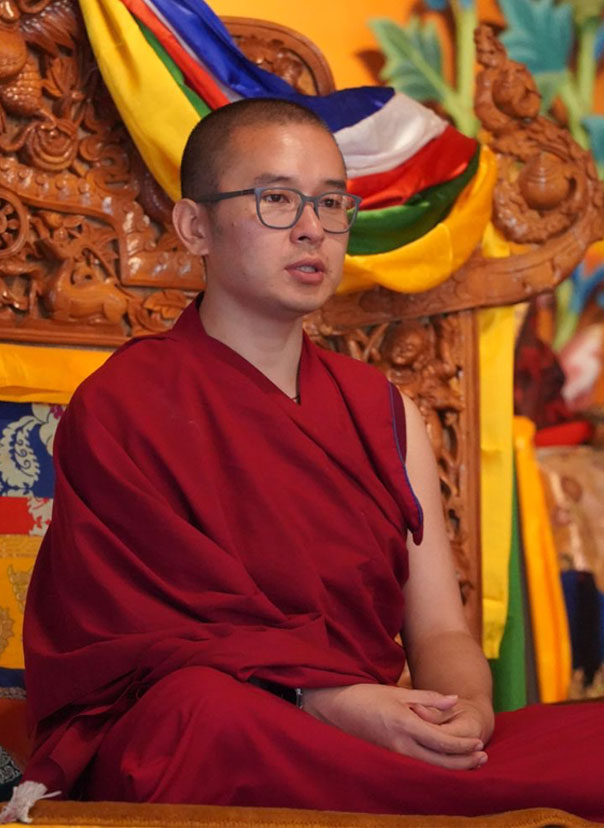
His Eminence Ngor Khangsar Shabdrung Rinpoche:
Beyond this life
Preparation for the journey through the bardo
Tibetan teachings on the process of dying and a guide to the states of mind after death
& Space for all your questions
More information below
None of us can avoid death, yet it is a journey few consciously prepare for. Tibetan Buddhism offers something unusual in this regard: a concrete and practical view of what dying entails and how one can prepare for it while still alive.
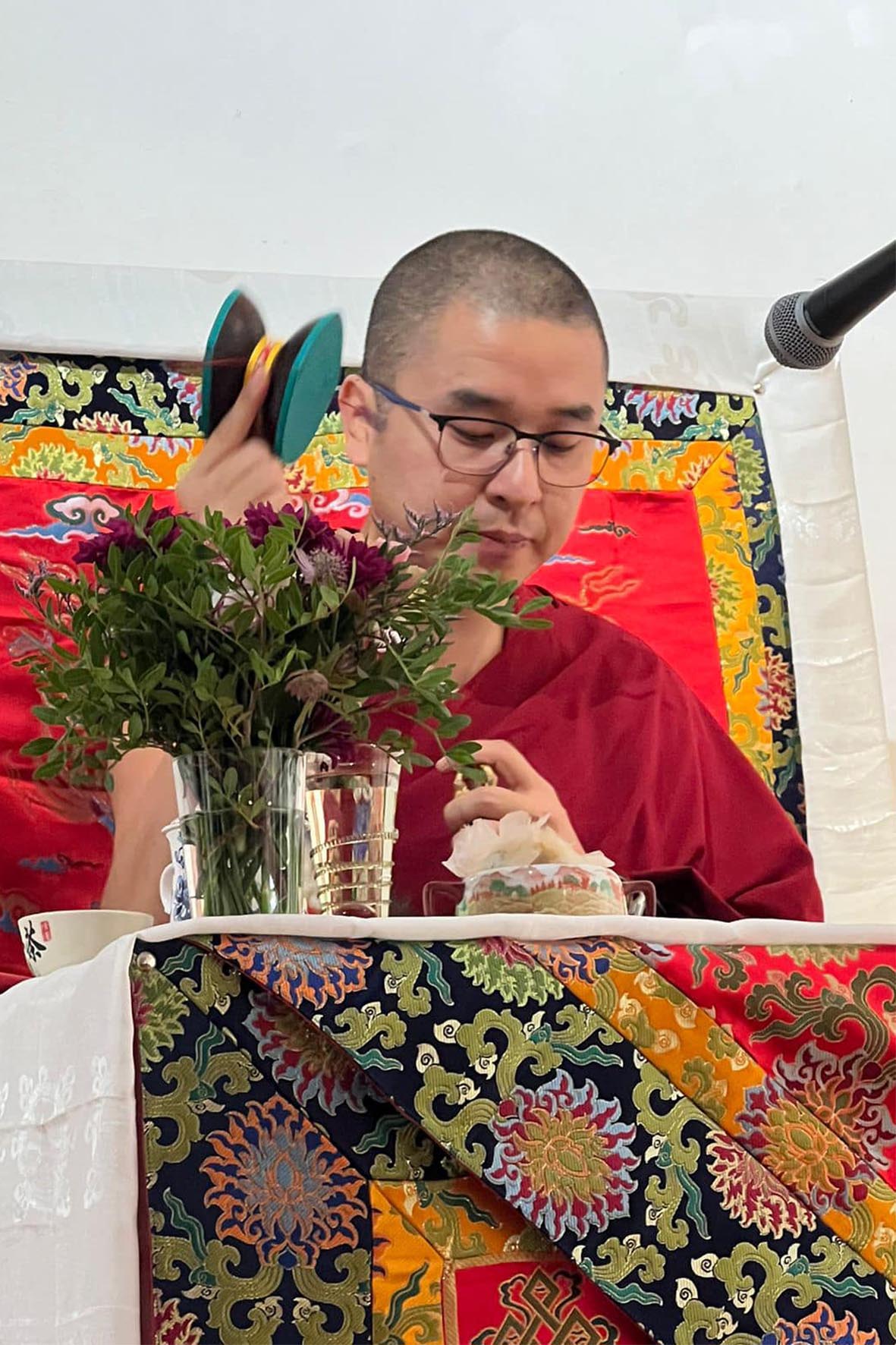
We warmly invite you this time to the intimate spaces of our traditional wooden house in Sloup v Čechách for a two-day teaching by His Eminence Ngor Khangsar Shabdrung Rinpoche, in which he will explain how to practice, the process of dying, the bardo states, and how our practice relates to these states, as well as how understanding these teachings can bring us greater peace and clarity of mind — not only at the end of life, but even now.
September 18 - 19, 2026
Venue: Sloup v Čechách, Potoční 95. More info
Practical information and registration
Language: Tibetan with interpretation into Czech
Contact: info@siddhartha.cz, +420 777 178 129
His Eminence Ngor Khangsar Shabdrung Rinpoche
Khangsar Shabdrung Rinpoche (b. 1990) is the head lama of the Khangsar labrang, one of the four monastic seats of Ngor Ewam Choden, a Sakyapa monastery founded by Ngorchen Kunga Zangpo. Recognized by His Holiness the Sakya Trichen, Rinpoche is the reincarnation of Khangsar Ngawang Khyentse Thupten Nyingpo (1913–1988), a past abbot of Ngor. Since his youth, Rinpoche has received extensive training and teachings in the sutras and tantras from His Holiness the Sakya Trichen, His Eminence the late Luding Khenchen Rinpoche, and other great masters. He primarily teaches and resides in Manduwala, and oversees communities of monks and nuns in northern India.
What is the bardo?
The Tibetan word bardo literally means an intermediate state – a transition between one state of being and another. This term is often used to refer to the state between death and rebirth, although Tibetan Buddhism distinguishes six such states, including life, dream, or deep meditation.
Perhaps the most famous guide through these states is the Bardo Thodol, an 8th-century text attributed to Padmasambhava, known in the West as the Tibetan Book of the Dead. It describes, for example, that after the experiences associated with the dissolution of the elements, the true nature of our mind first manifests. Whoever recognizes it in this moment is liberated. Whoever does not continues to the next stages, in which visions, sounds, and lights alternate – all as projections of one's own mind.
Lamas from the Tibetan tradition have repeated since ancient times: thinking about death does not mean being a pessimist. It means being prepared.
Space for all your questions
Since we will meet in a more intimate setting, we would like to take advantage of this and also offer you plenty of space for any of your questions. Not only those related to the topic, but also any others, regarding anything from your practice, for example. If you have questions, please write them in the form so we can pass them on to Rinpoche and also adjust the times of our meetings according to their number. Of course, you will be able to ask Rinpoche each of them personally. 🙂
How can you participate?
→ In person only - this event will not be streamed
→ September 18, 2026, 17:00 - 18:30
→ September 19, 2026 morning and afternoon, times to be specified.
→ Venue: Sloup v Čechách, Potoční 95
→ Please read the practical information and register at this link